

Load management is about controlling energy in a building so that fuses are not overloaded and the available energy is used optimally.
How does dynamic load management work?
Andreas, you are our expert when it comes to load management. What advantages does it offer for the operation of charging stations?
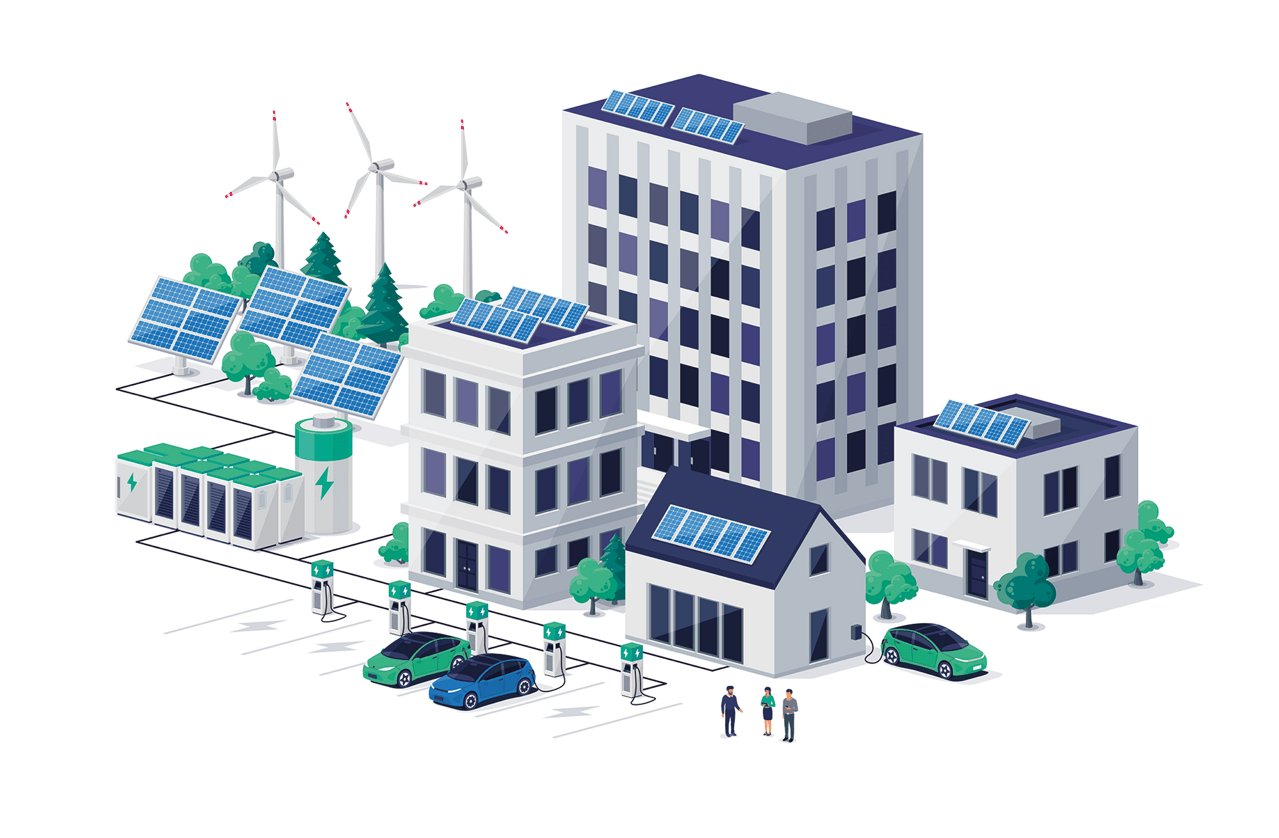
For dynamic load management for charging stations, we analyze energy consumption in the building and in the relevant outgoing circuits. If a lot of energy is needed elsewhere, we can reduce the energy supply to the charging stations to avoid high costs or an overload on the fuses. The same applies in reverse: if a lot of energy is available, we can release more energy for the charging stations.
In addition, dynamic load management makes it possible to connect more charging stations with maximum power to a fuse protection. The current consumption is monitored and the charging power is continuously reduced if there is a risk of overload. In practice, this means that ten 11 kW charging stations can be operated on a fuse that could theoretically only supply enough energy for four stations to be used at the same time. If only one user or a few users are charging at the same time, then the full charging power can be made available to them. If everyone wants to charge at the same time, then this is done at a reduced power, but charging can still continue.
We can also guarantee this protection in larger building complexes and across several levels of security circuits. A real-life example: a project with four levels – area distribution → building distribution → electric mobility distribution → flat belt. If there is a shortage of fuses somewhere in the area, the load management system kicks in.
How can dynamic load management be integrated into existing building structures and energy systems?
For dynamic load management, we measure the main connection of the building and usually also the main fuse for the charging stations. For larger systems with several fuse circuits, it often makes sense to measure these individually. To do this, we use our CC controller in combination with a wide range of measuring systems.
Thanks to Ethernet and Modbus, we are very flexible in terms of system architecture. In addition, synergies with existing interfaces and networks can reduce the amount of wiring required. The controller can therefore be installed in the basement of the main building and still manage the charging stations in the outdoor area of an adjoining building.
The possible applications
What cost and energy savings can companies achieve by using dynamic load management?
It is important not to get the wrong impression here: load management does not save energy in principle. The number of kWh on the bill remains almost the same. What we do, however, is distribute this energy better throughout the day, thereby reducing the peak load.
Charging stations are often used when the users arrive at their destination – whether at the end of the working day when the vehicle fleet returns or in the morning when the staff arrive at the office. The vehicles are often stationary for eight hours, while charging only takes three hours. With load management, we prevent all charging stations from charging at full power at the same time, thus reducing peak loads.
For example:
If we reduce the power of four 22 kW charging stations by 50% for one hour because operations are starting up at the same time, we already save 44 kW on the peak load. At a cost of CHF 7–16 per kilowatt for the peak load, this quickly adds up to a saving of several hundred francs per month.
Thank you Andreas for answering the questions.
Discover the advantages of dynamic load management! Let our experts advise you – contact us directly now or take a look at our brochure. We look forward to answering your questions!