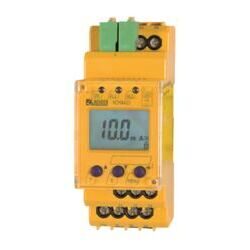
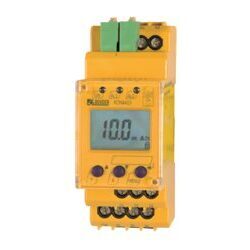
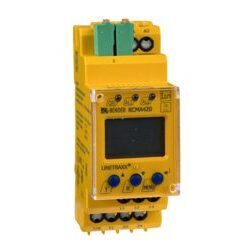
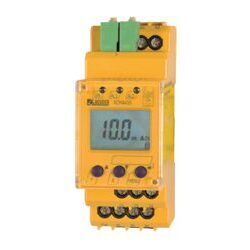
Residual Current Monitoring RCMA (Type B)
Thanks to differential current monitoring, you can detect critical operating conditions before they lead to unwanted operational interruptions, costly property damage, or even personal injury.
- Report Instead of Shutting Down
- Maximum system availability
- Innovative measurement technology
- Safety in all areas
For systems rated at more than 500 A, use only shielded current transformers.
At this current level and above, interference from conductors that are not properly aligned and centered within the current transformer becomes increasingly significant, resulting in less accurate measurement results. The shielded current transformer prevents this magnetic interference.
- Monitoring of fault currents, leakage currents, and insulation resistance
- Early warning
- Predictive maintenance of systems
- Monitoring of neutral conductors for overloading due to harmonic distortion
- Monitoring of fire-hazardous currents in fire-prone facilities
Definitions:
RCM – Residual Current Monitor
These devices monitor residual currents in electrical systems, display the current value, and signal when threshold values are exceeded.
RCMA & RCMB
Bender designation for Type B residual current monitoring devices in accordance with IEC 60755 for monitoring alternating currents, pulsating and smooth DC fault currents.
RCMS
Bender designation for multi-channel residual current monitoring systems, Types A and B, in accordance with IEC 60755, for monitoring alternating currents, pulsating DC fault currents, and smooth DC fault currents.
MRCDB – Modular Residual Current Devices
Their function is to trip a circuit breaker within a specified time if the residual current exceeds a certain value. They enable circuit breakers to be supplemented for personal safety and fire protection.
Application example of the RCMS460 system

In grounded power supply systems (TN/TT systems), the insulation resistance is indirectly determined by the magnitude of the fault current. Here, residual current monitors (RCMs) are used to monitor an electrical installation or circuit for a potential fault current or residual current (figure above). An alarm is triggered when the fault current exceeds a specified value. The RCM should be set so that the alarm is triggered before the system automatically shuts down in accordance with standards.
Filter
Differential current
Response value lΔn
Alarm relay mode of operation
Supply voltage
Filter
Reset filterResidual Current Monitoring RCMA (Type B)
Thanks to differential current monitoring, you can detect critical operating conditions before they lead to unwanted operational interruptions, costly property damage, or even personal injury.
- Report Instead of Shutting Down
- Maximum system availability
- Innovative measurement technology
- Safety in all areas
For systems rated at more than 500 A, use only shielded current transformers.
At this current level and above, interference from conductors that are not properly aligned and centered within the current transformer becomes increasingly significant, resulting in less accurate measurement results. The shielded current transformer prevents this magnetic interference.
- Monitoring of fault currents, leakage currents, and insulation resistance
- Early warning
- Predictive maintenance of systems
- Monitoring of neutral conductors for overloading due to harmonic distortion
- Monitoring of fire-hazardous currents in fire-prone facilities
Definitions:
RCM – Residual Current Monitor
These devices monitor residual currents in electrical systems, display the current value, and signal when threshold values are exceeded.
RCMA & RCMB
Bender designation for Type B residual current monitoring devices in accordance with IEC 60755 for monitoring alternating currents, pulsating and smooth DC fault currents.
RCMS
Bender designation for multi-channel residual current monitoring systems, Types A and B, in accordance with IEC 60755, for monitoring alternating currents, pulsating DC fault currents, and smooth DC fault currents.
MRCDB – Modular Residual Current Devices
Their function is to trip a circuit breaker within a specified time if the residual current exceeds a certain value. They enable circuit breakers to be supplemented for personal safety and fire protection.
Application example of the RCMS460 system
In grounded power supply systems (TN/TT systems), the insulation resistance is indirectly determined by the magnitude of the fault current. Here, residual current monitors (RCMs) are used to monitor an electrical installation or circuit for a potential fault current or residual current (figure above). An alarm is triggered when the fault current exceeds a specified value. The RCM should be set so that the alarm is triggered before the system automatically shuts down in accordance with standards.