
Shop
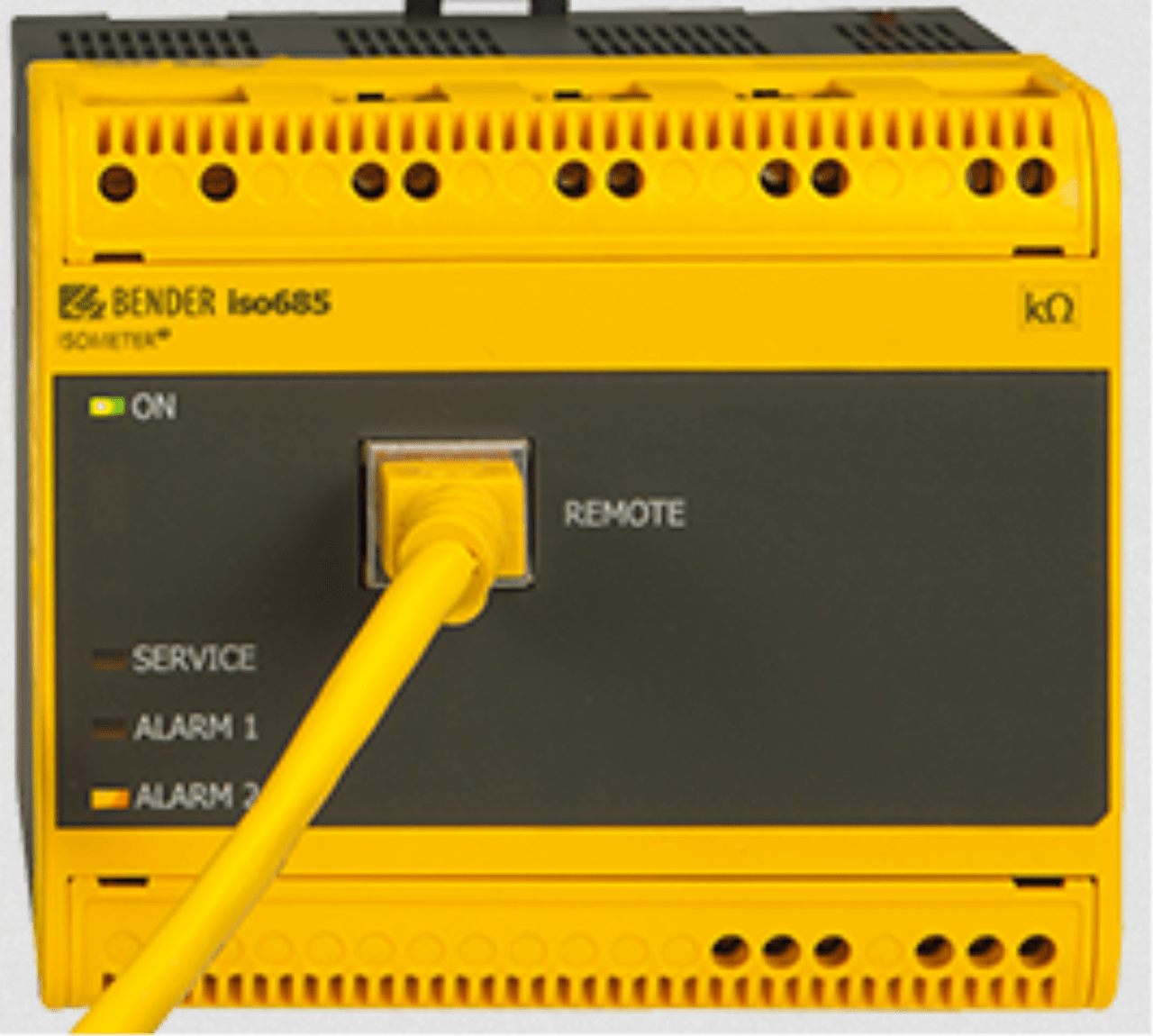
iso685-S-P Isolationsüberwachungsgerät
Insulation monitoring for IT systems in accordance with IEC 61557-8
Operation via FP200, web browser, or COM465
Threshold values from 1 kΩ to 10 MΩ, adjustable independently
Integrated web server and Modbus TCP/RTU
The ISOMETER iso685 is an insulation monitoring device for IT systems in accordance with IEC 61557-8. It can be used universally in AC, 3(N)AC, AC/DC, and DC systems. In AC systems, there may also be extensive DC-powered system components (e.g., power converters, inverters, controlled drives).
iso685-S:
The iso685-S model has no display and no control unit. It can be used in
used in combination with the FP200 and is operated indirectly through it.
Parameterization can also be performed via a web browser or a COM465.
“W” Option
Optionally, the device variants are available in the “W” option for extreme climatic and
mechanical stresses.
Key features:
· Predefined measurement profiles
· Reliable measurement of insulation resistance, voltage, capacitance, and frequency
· Integrated web server
· Modbus TCP/RTU
· Insulation fault detection
Features and Functions:
iso685-…-P
· ISOMETER® for IT AC systems with galvanically isolated rectifiers or inverters and for IT DC systems (IT = isolated systems)
· Automatic adaptation to the existing network leakage capacitance
· Combination of and other profile-dependent measurement methods
· Two separately adjustable response value ranges from 1 kÙ…10 MÙ
· Connection monitoring (monitoring of the test leads)
· High-resolution graphical LCD display
· Graphical representation of insulation trends over time (isoGraph)
· Automatic display dimming (submarine mode)
· Automatic device self-test
· History memory with real-time clock (3-day buffer) for storing up to 1,023 alarm messages with date and time
· Current or voltage output 0(4)…20 mA, 0…400 µA, 0…10 V, 2…10 V (galvanically isolated), proportional to the measured insulation value of the network
· Freely programmable digital inputs and outputs
· Ethernet interface with BCOM, Modbus TCP/RTU, and HTTP protocols
· RS-485/BS (Bender Sensor Bus) for data exchange with other Bender components using the Modbus RTU protocol
· Remote configuration via the Internet or intranet (web server/option: COMTRAXX® Gateway)
· Remote diagnostics via the Internet (only by Bender Service)
· ISOnet: Internal isolation of the ISOMETER® from the IT system being monitored (e.g., when multiple IT systems are interconnected)
· ISOnet Priority: Permanent priority for a device within the network
· ISOloop: Special function for ring networks (all networks are interconnected).
· isoData: Permanent, uninterrupted data transmission
· Test current generation for selective insulation fault detection
· Display of insulation faults selectively located by EDS systems
· Configuration of EDS systems
· EDSsync: Synchronous distribution of EDS trigger information in interconnected networks
· Custom texts for each measurement channel
EDS44x
· Insulation fault detection in AC, 3AC, and DC IT systems
· Up to 12 W, WR, and WS series current transformers can be connected
· Response sensitivity for insulation fault detection: EDS440 2…10 mA, EDS441 0.2…1 mA
· Response sensitivity for differential current measurement: EDS440 100 mA…10 A, EDS441 100 mA…1 A
· Component communication via BS-Bus (RS-485) or BB-Bus
Technical Features:
· For integrated IT systems and with a display for front-panel mounting (FP200)
· Supply voltage Us: AC 100…240 V - DC 120…240 V
· Frequency range Us: 50 Hz, 60 Hz
· Monitored IT system:
· - Nominal line voltage Un: AC 0…690 V (0…600 V UL)
· - Nominal line voltage Un: DC 0…1000 V (0…600 V UL)
· Threshold value Ran1 (Alarm 1): 1 kΩ…10 MΩ (10 kΩ)
· Threshold value Ran2 (Alarm 2): 1 kΩ…10 MΩ (40 kΩ)
· Graphic display, 127 x 127 pixels, 40 mm x 40 mm
· Digital inputs: 3 / Digital outputs: 2
· Analog output: 1
· Interfaces: Ethernet-TCP/IP/HTTP / RS-485 / BMS
· Dimensions: (W x H x D) 107.5 mm x 100 mm x 110 mm
Applications:
· AC, DC, or AC/DC main power circuits
· AC/DC main circuits with directly connected DC components such as power converters, inverters, and controlled drives
· UPS systems, battery networks
· Heating devices with phase-angle control
· Systems with switching power supplies
· IT systems with high leakage capacitance
· Systems with insulation fault detection


